
 Laura
Laura
Somewhere in a backroom at each of the 16 host stadiums this summer, a technician is doing something that would have seemed absurd a decade ago: charging a soccer ball. Not a phone. Not a tablet. The ball. The official match ball of the 2026 FIFA World Cup runs on a battery, and if that detail doesn’t immediately make you want to know everything else going on under the hood of this tournament, then this blog might not be for you.
For the rest of us who instinctively wonder what’s powering the experience and not just who’s playing in it, the 2026 World Cup is a fascinating moment. It’s the largest football tournament in history by almost every measure: 48 teams, 104 matches, 16 host cities, an estimated 6 million fans in attendance, and a global broadcast audience that FIFA projects could approach 5 billion cumulative viewers. Pulling that off without the digital infrastructure collapsing under its own weight is an engineering challenge on par with anything happening on the pitch.
The adidas TRIONDA Smart Ball
If you’ve seen any of the buzz surrounding the tournament, you already know there’s something different about this year’s match ball. adidas introduced the official match ball for the World Cup in October 2025 and it is far more than a design flex. The ball’s name, TRIONDA, is a nod to the three host nations (“TRI” for three and “ONDA” for the Spanish word wave) for the flowing three-wave design, but what’s inside the ball is where the story gets remarkably interesting.
At the heart of the TRIONDA is a 500Hz inertial measurement unit (IMU) motion sensor chip. The ball will be transmitting live positional data (like speed, spin, direction and exact point of contact) 500 times every second to the Video Assistant Referee (VAR) system. That’s significantly faster than standard broadcast frame rates, creating an almost impossibly granular real-time picture of the ball’s behaviour.
The sensor technology itself has also evolved since the 2022 Qatar World Cup. That year’s ball, the Al Rihla, suspended its sensor in the centre using support wires attached around the air bladder. The TRIONDA takes a cleaner approach, embedding the 14 gram sensor chip directly into a dedicated pocket inside one of the ball’s side panels, with precisely positioned counterweights added elsewhere to preserve the ball’s aerodynamic balance and performance. Players, apparently, cannot feel any difference.
Which brings us back to that battery. The ball has to be charged before every match. It runs on a rechargeable battery with roughly six hours of life, which is more than enough for a full match, plus stoppage time. A technician somewhere inside the stadium is quietly plugging in the official ball of the world’s most-watched sporting event, and that is one of the more surreal images in modern sports.

The Invisible Referee & AI Avatar System
The smart ball doesn’t operate in isolation. It’s one node in a much larger officiating network and together they represent one of the most significant changes to how football is refereed in the sport’s history.
Around each of the 16 host stadiums, 12 dedicated tracking cameras are positioned beneath the stadium roof. These cameras simultaneously track the ball’s position and up to 29 skeletal data points on every single player (things like shoulders, hips, knees and ankles) 50 times per second. When the TRIONDA’s sensor detects the precise millisecond of a kick, it fuses that data with the player-tracking cameras to generate an automated offside referee. The whole process, which once took 70 seconds on average, is expected to take closer to 20.
But FIFA didn’t stop there for 2026. In a science fiction like development announced at CES in Las Vegas, every one of the 1,248 players from the 48  competing nations has been digitally scanned to create AI-enabled 3D avatars. Each player steps into a scanning chamber during their pre-tournament photo shoot that captures highly accurate body-part dimensions. Those avatars are then layered on top of the skeletal tracking data to make offside decisions more accurate and visually more comprehensible for fans watching in stadiums and at home. Remember the controversy when Premier League offsides were displayed as spindly wireframe skeletons? FIFA is trying to put that era behind them with photorealistic 3D recreations of the actual players.
Lenovo is FIFA’s official technology partner running this platform called Football AI Pro and the parallels to video game rendering technology are not lost on anyone following along. The system tracks 172 million data points per team match, a figure that puts the old standard of 600,000 data points per team into a completely different century.
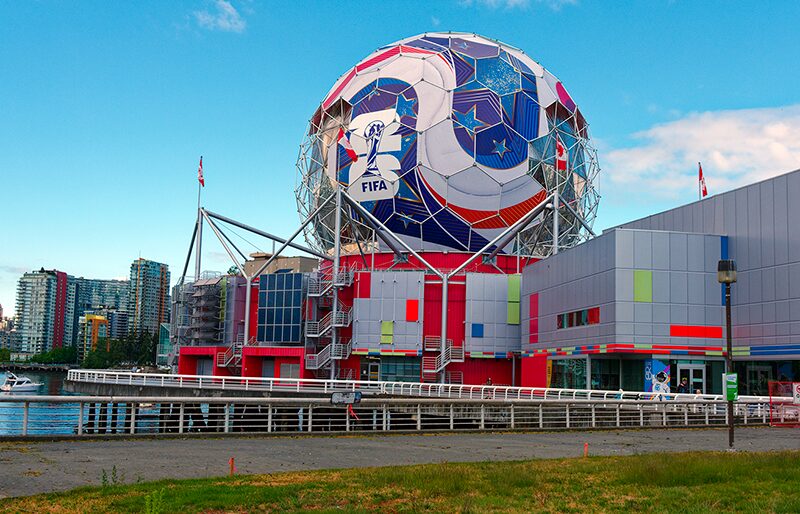
If you’re curious what this actually looks like beyond the broadcast graphics, Vancouver locals will get a rare hands-on look this summer. Science World is hosting Soccer & Technology from the FIFA Museum, an interactive exhibit that explores the same systems shaping the 2026 tournament, including the adidas TRIONDA ball, advanced refereeing tools, and player tracking technology. It’s a chance to step inside the mechanics behind decisions that now happen in seconds on the pitch.
Inside the Digital Stadium
Walk into any of the 16 host venues this summer and you’re stepping into what is essentially a sophisticated IoT network that was quietly running before FIFA even arrived. Venue operators across Canada, the US and Mexico are managing sensor networks that simultaneously monitor crowd movement, structural loads, and energy consumption in real time. FIFA is, in a sense, running the world’s largest football tournament on top of a smart building infrastructure designed for something else entirely.
But the fan-facing technology is where things get exciting. Verizon, the official telecom partner for the tournament, has upgraded 5G capacity across all host venues. The goal is to allow the infrastructure to handle all of the fans trying to share video, access their mobile tickets and check stats simultaneously without a lot of congestion.
FIFA has also introduced a Fan ID card program for 2026. Every ticketholder can collect an NFC-enabled card from fan information booths at all 16 stadiums. A tap of the card to a smartphone unlocks stadium information, personalizable tournament merchandise, and AR-powered video messages. Lenovo has gone further, building digital twins of all host venues. These virtual replicas of the physical stadiums will be used to simulate crowd flows, emergency scenarios, and operational bottlenecks in software before the fans show up in person.
For those watching from their seats, the official FIFA World Cup 2026 app introduces “Enhanced Football Intelligence” where you can point your phone at the pitch and see real-time player names, speeds, and passing lane data overlaid on the field via augmented reality. It’s the kind of feature that, a decade ago, would have sounded like something from a tech demo. In June 2026, it’s just the official app.
The Cybersecurity Match Running in the Background
Here’s the part that doesn’t make the highlight reels but matters just as much. A tournament of this scale is an attractive target for cybercriminals. Security researchers have mapped out the key threats heading into the tournament: financially motivated fraud through fake ticket sales, phishing campaigns impersonating FIFA and official sponsors, DDoS attacks aimed at ticketing and streaming infrastructure, and potential state-sponsored disruption during high-visibility matches.
The ticketing system draws the most scrutiny.  With mobile-only tickets and digital access controls now the standard, the risk is considerably wider than in the era of paper tickets. Security experts are advising fans to buy tickets through the official FIFA platform only, use credit cards with chargeback protection, and treat any offer arriving via Telegram, WhatsApp or social media DMs as suspicious until proven otherwise.
This is the same hard lesson Blue Jays fans learned during the 2025 ALCS, when convincing fake ticket sites with perfectly valid SSL certificates nearly locked thousands out of the game. The padlock icon in your browser means your connection to that server is encrypted, but it says nothing about whether the seller is legitimate. Verifying the actual domain name, checking that you’re on FIFA.com and not a lookalike site, is the fan’s first real line of defence.
The Digital Engine Powering the Pitch
While a 14-gram sensor inside a soccer ball captures our imaginations, the technology required to broadcast that data to billions of people simultaneously is a massive operation happening entirely out of sight. When fans in Vancouver steams the matches, or a viewer in Norway checks live tracking data, they aren’t waiting for a data request to travel to a single, central data centre. Instead, a global Content Delivery Networks (CDNs) cache static content and live-stream data packets at edge servers distributed globally. This bring the processing power closer to the end-user, keeping video playback smooth and data latency down to a fraction of a second.
The most critical asset running behind the scenes, however, is a redundant Domain Name System (DNS) architecture. With hundreds of millions of fans simultaneously hitting the official app, ticketing portals, and media streams, standard network infrastructure would face severe risk of localized outages or traffic spikes. To mitigate this, enterprise architectures rely on Anycast DNS networks. Anycast functions by routing user traffic to the nearest available server node among multiple identical destinations worldwide. If a specific server faces an intense traffic spike or a technical failure, the network instantly reroutes requests to the next closest node. For a multi-city, tri-nation tournament, this level of fault tolerance ensures the digital entry points remain completely open, preventing a virtual bottleneck when the world is trying to watch.
The Final Score for Tournament Tech
Ultimately, the 2026 World Cup demonstrates how professional sports have transformed into massive data-management operations. The tournament is no longer just an athletic competition, it’s a live demonstration of cutting-edge technology, IoT architecture and global security.
From the technician charging a soccer ball in a stadium backroom to the Anycast networks routing millions of fans’ web requests every second, the modern sporting experience is completely shaped by code and infrastructure. When the tournament kicks off in a few days, the most impressive performance won’t just be the players on the pitch, it will be the silent and flawless execution of the tech keeping the entire global event online.
And if you happen to be in Vancouver, this isn’t all happening at a distance. Science World’s Soccer & Technology from the FIFA Museum exhibit brings many of these systems into a physical space, turning the invisible infrastructure behind the tournament into something you can actually explore. This incredible exhibit will be available to the public to explore until September 7, 2026. Get your tickets today!
Key Takeaways
- The Ball Requires a Charge: The adidas TRIONDA uses an internal 500Hz motion sensor to stream exact positioning data to VAR 500 times per second, running on a six-hour rechargeable battery.
- AI Offside Decisions: 12 tracking cameras capture 29 skeletal points per player, combining 3D player avatars to drop offside review times from over a minute down to 20 seconds.
- Smart Stadium Infrastructure: Venues utilize high-density 5G, IoT sensor networks, and live AR app overlays to transform the live fan experience.
- Enterprise-Grade Hosting: CDNs and Anycast DNS networks distribute the traffic load globally, preventing site crashes and keeping streams running smoothly.
- Strict Digital Security: Mobile-only ticketing requires fans to verify domain names of ticket sites directly, as attackers frequently use realistic lookalike sites to intercept payments.