
 Julianna
For years, managing SSL certificates followed a familiar pattern: purchase a certificate, install it, set a reminder, and repeat the process when it came time to renew. That approach worked well enough when certificate lifespans were long and most organizations only had a handful of domains to manage.
But the SSL landscape is changing — quickly.
At Webnames and Webnames Corporate, we’ve spent decades helping Canadian brands and businesses of all sizes secure their websites, apps and infrastructure with trusted SSL/TLS certificates. As both the threat environment and industry standards evolve, we continue to expand our offerings to help organizations stay ahead.
That’s why we’re excited to introduce Automated (ACME) SSL certificates in our product lineup — a new generation of SSL solutions designed to eliminate manual management and keep your sites and platforms secure in the face of shortening SSL lifespans.
With new ACME options from leading Certificate Authorities including GeoTrust, RapidSSL, Sectigo, and PositiveSSL, and support for both single domain and wildcard configurations, Webnames now offers a portfolio of fully automated SSL solutions built for today’s realities, with more options to come — and tomorrow’s requirements.
SSL Is Changing — And Manual Processes Are Breaking Down
The shift toward automation isn’t just a convenience. It’s being driven by major changes at the industry level. Over the next several years, SSL/TLS certificate lifespans are being reduced significantly as part of a broader push to strengthen internet security. Certificates that once lasted more than a year are being shortened in phases:
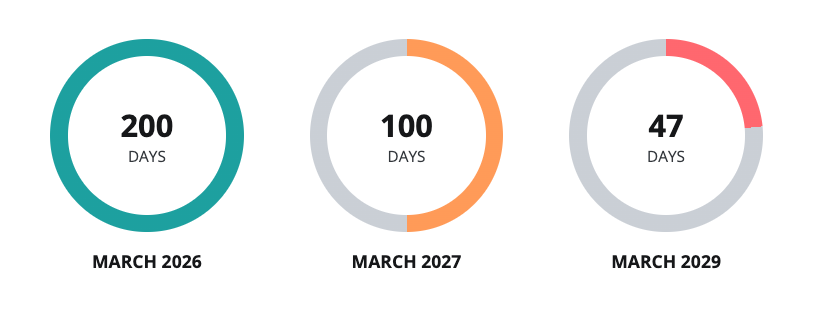
At the same time, domain validation data — the proof that you control a domain — will also need to be refreshed more frequently.
From a security standpoint, this is a positive change. Shorter lifespans reduce the window in which compromised certificates can be abused and allow the industry to respond more quickly to evolving threats. Operationally, however, it brings increased administrative challenge.
If you’re managing SSL certificates manually, you’re now looking at a future where renewals happen multiple times per year — per certificate. To illustrate this better, here’s what the renewal frequency looks like for an organization with, for example, 10, 50 and 100 SSL certificates to manage with upcoming scheduled lifespan reductions:
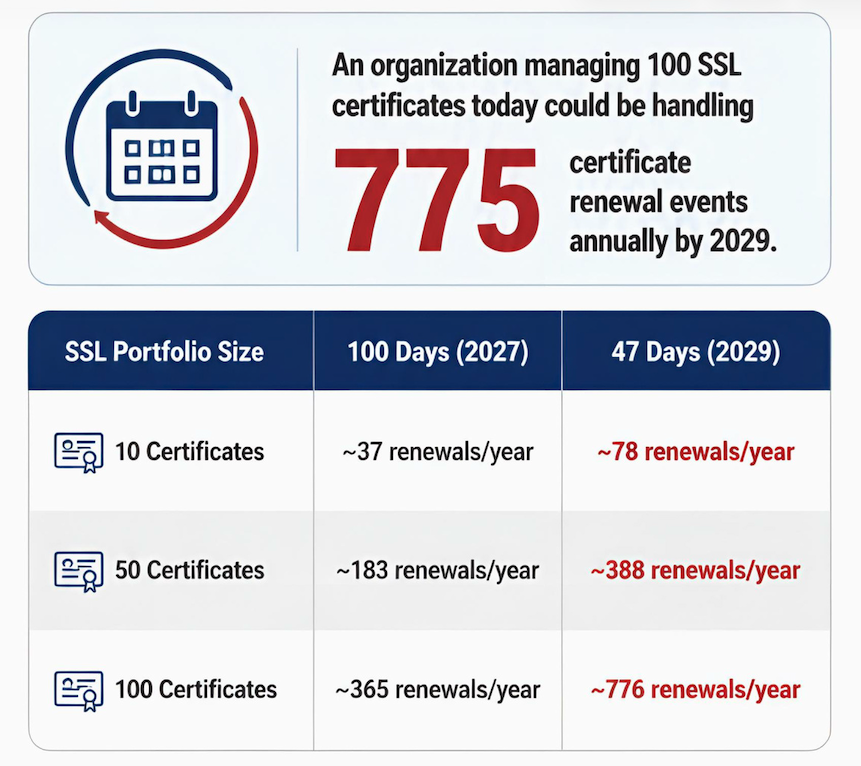
For organizations with multiple domains, applications, or environments, you can see how renewal frequency can lead to increased risk around missed renewals and make manual SSL administration unsustainable in the case of higher certificate volumes. In short, traditional SSL management simply will not scale anymore.
The Shift to Automation
Automated SSL certificates use the ACME protocol to handle the entire certificate lifecycle — from issuance and validation to installation and renewal — without manual intervention. Instead of tracking expiration dates or repeating configuration steps, your server communicates directly with the certificate authority and manages everything in the background. Once configured, the process becomes largely invisible with certificates getting issued automatically, and renewals happening before expiration. With these updates getting automatically deployed and ACME running in the background, your websites and platforms stay continuously protected.
What Is ACME, and Why Does It Matter?
ACME (Automated Certificate Management Environment) is the open standard that has quickly become the foundation for modern certificate automation and that sits as the engine of this shift. ACME allows your server — through a small piece of software called an ACME client — to securely request and manage SSL certificates directly from a certificate authority. Instead of filling out forms, generating CSRs, and validating your business identity via email, the process becomes programmatic and looks something like this:
- Your server requests a certificate
- The certificate authority verifies control of the domain
- The certificate is issued and installed automatically
- Renewal is handled before expiration
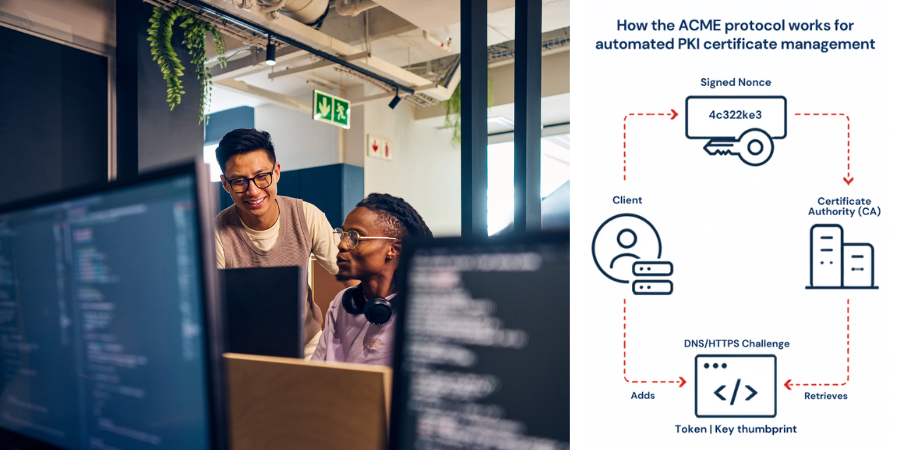
All of this happens over secure, standardized communication, ideally without human intervention because ACME certificates are designed to work with ACME clients and automation workflows, not to be managed through traditional, manual processes. For a more thorough technical explanation visit our Automated/ACME SSL Help Guide.
The Biggest Benefit: Continuous Protection Means No More Active SSL Management
It’s easy to focus on features like automation, faster issuance, or improved workflows. Arguably, however, the biggest benefit of ACME to most technical teams is significantly reduced workload and mindshare. Reminders no longer need to be scheduled, tracking via spreadsheets and project management systems gets largely phased out, and the damage caused by an expired certificates is virtually eliminated.
For IT teams and business owners alike, that directly translates into more time for higher value initiatives and a more robust technical infrastructure.
Paid ACME SSL vs Free Options: What’s the Difference?
While larger organizations and brands typically use paid, professional solutions and trusted Certificate Authority brands, smaller businesses will be familiar with free SSL solutions like Let’s Encrypt and their ACME options. While these provide strong encryption, commercial ACME SSL certificates offer important advantages to any business use case.
With a paid solution from a trusted certificate authority like Sectigo, GeoTrust, RapidSSL and others carried by Webnames you also gain:
- Higher Levels of Trust – Free options typically offer Domain Validation only. Paid certificates allow for Organization Validation (OV) and Extended Validation (EV), helping verify your business identity and build user trust.
- Financial Protection – Commercial SSL certificates include warranties that protect against certain risks, providing an added layer of assurance for your business and your customers.
- Dedicated SSL Support – When something goes wrong, having access to expert support can make all the difference, especially in complex environments. Webnames customer support has deep technical SSL expertise and fast response times which can be invaluable in the face of unforeseen issues.
- Broader Compatibility – Commercial CAs maintain extensive trust chains that ensure compatibility across a wider range of devices, systems, and legacy environments, making them more reliable.
When combined with ACME automation, these advantages create a powerful solution that balances efficiency with reliability and trust.
Who Should Be Using Automated SSL?
A common misconception is that automation is only necessary for large enterprises or really only benefits organizations that have numerous SSL in play. In reality, any organization or business, no matter its size, that wants to reduce risk and save time can benefit from moving to automation as soon as possible.
For smaller businesses, automation removes the burden of managing renewals and reduces the chance of frustrating or costly mistakes. For growing organizations, it provides a scalable way to keep up with increasing numbers of domains and services.
In the case of IT teams and enterprises, automation is a business requirement of managing complex infrastructure efficiently and securely. If you have more than a handful of certificates, or anticipate growing to need this, automation is indisputably the smarter approach.
Choosing the Right Automated SSL Certificate
For most organizations, moving to Automated SSL is not simply a matter of selecting the least expensive certificate or the most recognizable brand. The right solution depends on your security requirements, infrastructure, certificate volume, and long-term certificate management strategy. With shorter lifespans looming, it’s worth taking a step back and evaluating not only which certificates you need today, but how those certificates will be managed over the next several years.
Start With the Level of Validation You Require
The first consideration is the level of trust and validation appropriate for the websites, applications, and services you are securing.
Domain Validation (DV) certificates verify control of a domain name and are the simplest certificates to automate. They are ideal for many websites, internal applications, APIs, SaaS platforms, development environments, and cloud-based infrastructure. Because validation is automated, DV certificates are often the easiest place for organizations to begin their automation journey.
Organization Validation (OV) certificates provide an additional layer of business verification by validating the legal organization behind the certificate. They remain a popular choice for public-facing corporate websites, customer portals, and environments where demonstrating organizational legitimacy remains important.
Webnames’ initial Automated SSL rollout focuses on DV certificates, with Automated OV solutions scheduled to follow in the coming weeks and months.
Determine the Scope of Coverage Required
Next, consider how many endpoints need protection and how your environment is structured.
A Single Domain certificate secures one fully qualified domain name and is often the best option for organizations protecting a small number of websites or services.
A Wildcard certificate secures a root domain and its first-level subdomains, making it particularly effective for organizations with numerous applications, development environments, customer portals, or dynamically created subdomains. Rather than managing separate certificates for every host, one wildcard certificate can simplify administration considerably.
Organizations with a growing number of subdomains often find that Wildcard SSL certificates provide a more scalable and cost-effective long-term approach. We can help you compare and choose the right automated Wildcard SSL options for your needs and growth.
Select the Right Automation Model
Not all Automated SSL solutions work the same way. For organizations looking to automate certificates one at a time, traditional Automated SSL offerings such as GeoTrust DV + Automate, RapidSSL DV + Automate, GeoTrust Wildcard + Automate, and RapidSSL Wildcard + Automate provide automated issuance, installation, and renewal while maintaining the familiar certificate ownership model many teams already understand.
Organizations seeking greater flexibility and long-term scalability may wish to consider Certificate-as-a-Service (CaaS) offerings, such as:
- Sectigo ACME Certificate-as-a-Service (Single Domain and Wildcard)
- PositiveSSL ACME Certificate-as-a-Service (Single Domain and Wildcard)
Unlike standalone certificates, Certificate-as-a-Service models allow organizations to add domains and wildcard domains over time under a centralized subscription structure. This can be particularly attractive for growing organizations whose SSL requirements continue to evolve.
Consider How Validation Will Be Automated
All ACME SSL certificates require an ACME client to prove control of the domain being secured.Most organizations will use one of two challenge methods:
HTTP-01 Validation places a validation file on the web server. It is generally the simplest approach for publicly accessible websites and web servers.
DNS-01 Validation verifies ownership through DNS records and is often preferred for wildcard certificates, internal applications, cloud environments, and infrastructure sitting behind load balancers or firewalls. DNS validation is also the preferred option for organizations pursuing more advanced automation at scale.
When evaluating Automated SSL, it is important to ensure your hosting, server, or DNS provider can support the validation method you intend to use.
Think Beyond the Certificate
One of the biggest mistakes organizations make is viewing automation as a replacement for certificate governance. Automation removes much of the manual work associated with renewals, but organizations still need visibility into what certificates exist, where they are installed, who owns them, and whether automation is functioning properly. Organizations managing larger certificate footprints should consider pairing automated SSL certificates with:
- SSL monitoring and expiry alerting
- Certificate inventory and discovery tools
- Certificate tagging and classification
- Centralized reporting
- Regular reviews of automation credentials and DNS integrations
Automation reduces administrative burden, but visibility will always remain essential. Webnames and Webnames Corporate have a wide range of SSL management tools and features, plus the human expertise organizations should reliably have access to if needed.
Adopt the Perspective of Building an Automation Strategy, Rather Than Buying a Certificate
As certificate validity periods continue to shrink, organizations should think less about individual certificate purchases and more about developing a sustainable certificate management strategy. For some organizations, that may mean moving a handful of websites to Automated DV SSL certificates. For others, it may involve establishing ACME workflows, implementing monitoring and governance tools, and standardizing certificate management across multiple environments.
The key takeaway is to begin planning now. The further certificate lifespans shrink, the more difficult manual certificate management becomes.
Ready to Stop Thinking About SSL?
Webnames’ Automated SSL portfolio will continue to expand throughout 2026 with additional DV and OV options from leading Certificate Authorities, giving organizations greater flexibility in selecting the right balance of validation, automation, scalability, and cost.
If you’re unsure where to start, the Webnames Corporate team can help assess your current environment, identify automation opportunities, and recommend the best Automated SSL solution for your organization’s needs.
With Webnames as your SSL partner, you can shift from reactive management to a proactive, automated approach that keeps your sites, apps and platforms secure. Here are some places you can begin:
- Browse our Automated SSL certificate options
- Talk to our team about your specific requirements
- Connect with Webnames Corporate for enterprise SSL Automation solutions
Set it up once and let automation handle the rest. We’re here to help you move through this changing SSL landscape seamlessly.